Podążaj za instrukcjami w poniższym filmie, aby zobaczyć, jak zainstalować naszą stronę jako aplikację internetową na ekranie głównym swojego urządzenia.
Informacja: Ta funkcja może nie być dostępna w niektórych przeglądarkach.
Używasz przestarzałej przeglądarki. Może ona nie wyświetlać poprawnie tej lub innych stron internetowych. Powinieneś zaktualizować swoją przeglądarkę lub użyć alternatywnej przeglądarki.
Security update: PowerDNS 5.1.5 instead of 5.1.4. It fixes PowerDNS Security Advisory 2026-13 (CVE-2026-73206): a crafted DNS packet with name compression pointers could keep the server busy until it stopped answering. Zones, records, DNSSEC keys and settings stay as they are, and PowerDNS's log no longer asks for a security update.
Minor
In Polish, a snapshot made before a change sent by WebPortico now reads "Przed zmianą wprowadzoną przez WebPortico".
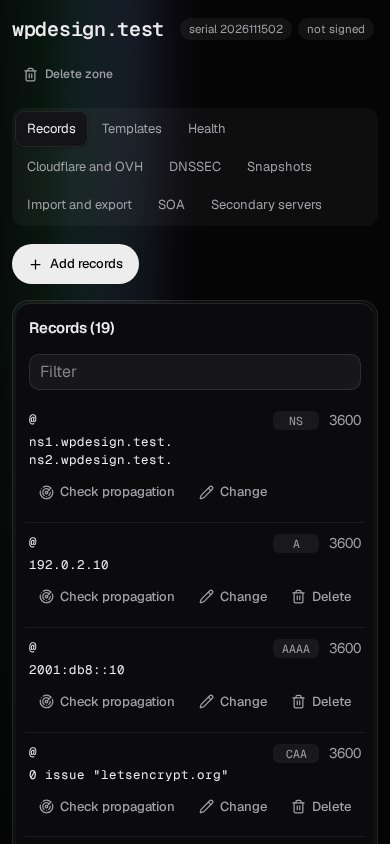
The panel on a phone: under 641 px wide, one bar at the foot of the screen holds Zones, Provider accounts, Settings and Menu (the language, the theme and Sign out). The zone list is its own page, an open zone takes the whole screen, and the buttons are large enough for a finger.
Minor
The panel draws the same line icons as Rtorrent 16, one icon for each action, and every Cancel has its icon.
A field's description waits under a "?" beside its label.
A snapshot's reason is shown in the panel's language, older snapshots included.
The templates sit in two columns, and long fields such as an IPv6 address are no longer cut short.
The first sign-in is no longer limited to 60 minutes after the panel starts: a computer on the local network can set the password at any time until one is set.
Secondary servers for a zone: a zone can now name up to 8 secondary servers (IPv4 or IPv6 addresses), for example your internet provider's secondary DNS. Only these servers can copy the zone by a zone transfer (AXFR or IXFR over TCP); every other address is still refused. PowerDNS sends them a change notice (NOTIFY) after each change, and never notifies the name servers the zone lists. The zone's new Secondary servers tab shows the preview before you save, each server's last zone transfer, and the serial number PowerDNS last sent the notice for.
Minor
Other packages on the NAS can send TurboDNS a whole zone file through the local hand-off, together with the zone's secondary servers and serial number settings, to import a domain from another server. The preview says which serial number the change will give.
A TXT record at _domainkey itself (the old DomainKeys policy record that Plesk writes) no longer blocks an import.
The SOA tab says that its timers matter for secondary servers and points to the new tab.
Clearer wording in the panel: the review before a change is headed Preview of changes, buttons read Add key, Delete key, Delete zone, Change proxy status and Change password, and messages such as "Cache rules updated." say the result. No zone, record or setting changes with this update.
Settings lists the NAS's LAN address first: IPv4 before IPv6, and in each the addresses of the network card or virtual switch that carries the default route before the others. Until 1.3.0 the order of the network interfaces could put another network's address first, and the check of names outside your zones asked that address. TurboDNS still answers on every address where port 53 is free.
Settings warns when the NAS asks only itself for names. With Connect to DNS server on Automatic in Network & Virtual Switch, the NAS takes its DNS server from the router, so once the router hands out the NAS, the NAS gets no names while TurboDNS is stopped or before it starts. The warning names the setting to change: Connect to DNS server on Manual, with your router's or your provider's DNS server. TurboDNS never changes it itself.
TurboDNS can be the DNS server of your network. A device that uses the NAS as its DNS server gets your zones from TurboDNS and every other name from the internet: Unbound 1.26.1, new in the package, looks them up from the root servers itself, and follows a CNAME of your zone that points outside it.
Resolvers on the internet get the same answers as before: a small front of TurboDNS's own holds port 53 and sends them to PowerDNS unchanged, with the AA bit and your zones' live DNSSEC signatures. Only devices of your own network get names outside your zones, so the NAS is no open resolver, even with port 53 forwarded.
Settings shows the addresses to give as the DNS server, each with a copy button, and whether names outside your zones resolve right now.
Minor
Zone transfers are off, and the front refuses AXFR, IXFR, NOTIFY and UPDATE itself. TurboDNS feeds no secondary, so nothing that worked before stops.
Unbound keeps no copy of your zones: a record you change is answered at once, and a new zone within a second.
Unbound validates no DNSSEC signatures, because a wrong clock after a power cut would otherwise fail every signed name.
While the NAS is off, devices that use it as their DNS server get no names at all.
The package carries the licence texts of all its parts in licenses/, with a NOTICE naming each source archive and its SHA-256.