Podążaj za instrukcjami w poniższym filmie, aby zobaczyć, jak zainstalować naszą stronę jako aplikację internetową na ekranie głównym swojego urządzenia.
Informacja: Ta funkcja może nie być dostępna w niektórych przeglądarkach.
Używasz przestarzałej przeglądarki. Może ona nie wyświetlać poprawnie tej lub innych stron internetowych. Powinieneś zaktualizować swoją przeglądarkę lub użyć alternatywnej przeglądarki.
The voice-over no longer talks over itself. Two lines are never heard at once, in a new film and in the Media studio's Preview voice-over. A long line starts a little sooner and is read at most 1.1 times faster, with a short pause between lines, the way Polish voice-over readers do it. A short reply of up to three words is left out when there is no room for it, and a line that still does not fit ends at a pause.
What a voice-over costs. The Media studio guide has a table of what one episode costs with each engine: free on the NAS, about 0.86 USD with ElevenLabs Eleven v4 Turbo, about 2.80 USD with OpenAI's voice.
Minor
Quickly create film with voice-over no longer warns about subtitles that are less than half a second off. When subtitles are really off, the warning says by how many seconds, with Match to speech and Keep as they are right under it.
Both voice-over windows show short "name: value" rows, and every "?" opens under its row instead of covering the buttons.
On Quick access and the Dashboard the speed tiles' fill now reaches the right edge of the tile.
Files: an episode's files stand together. Sorted by name, the files of one episode or one film (the film, its voice-over film, its subtitles, its .nfo and its Media studio project) stand next to each other, the .nfo first, with a dashed line between episodes. A release folder or a folder with one film looks as before.
Files: the end of a long name stays in view. On a phone, on the tiles and in the file pickers a long name takes up to two lines, and the second line always ends with the end of the name (.nfo, .pl.srt, .2.pl.srt, - Polski (lektor).mkv), so you can tell the files of one episode apart.
Files: colours for subtitles, NFO and project files. Subtitles, text and NFO files, .torrent files and Media studio projects have colours of their own in Files, the file pickers and a torrent's file list. The colour legend under "?" lists them.
Minor
Files' rows and tiles start further from the edge, as the rows in Quick access do. On a phone the Size heading stands over the sizes.
Preview voice-over in the Media studio lowers the film as soon as you switch it on and keeps it lower after a pause or a jump. Until now each Play started at full volume until the next subtitle came close.
Voice-over profiles measured on real Polish voice-over tracks. The Polish voice-over tracks of several films were measured: most keep the film at one level under and between the lines, and the voice starts a little after its subtitle. The new default, Classic voice-over, keeps the film 6.5 dB lower all through and starts each line 0.85 s after its subtitle. Three more profiles (Film ducked under the voice, Quiet voice-over and Film lowered slightly under the voice) are under Voice-over profile on a voice-over track's menu in the Media studio. AC-3 and E-AC-3 sound is now read at its full range whenever it is mixed or measured.
The subtitles are checked against the film before you pay for a voice-over.Quickly create film with voice-over (until now Add voice-over) first compares the chosen subtitles with the film's speech. They match; or they are out of time, and Match to speech shifts them; or they belong to another cut of the film, and nothing is downloaded, translated or read until you choose Read them anyway. Italic marks, line-break marks and tags in the subtitles are no longer read aloud.
Speed limits on iPhone. The limit on the Download and Upload tiles of Quick access and the Dashboard is saved when you leave the field: Done on the iPhone keyboard, Tab, or a tap outside it. Escape and Cancel keep the old limit, and the tile says whether the new one was saved.
Files: selection mode. The checkbox column appears only after Select (with a mouse too). Files draws its own icon for each file type with the extension on it, and Files and the folder pickers open at the last folder you used.
The Media studio on a phone or tablet.Show button names in the toolbar and in Scraper history names every icon button at once, and a finger held on one icon names that one. A long press no longer selects text, a clip is trimmed by the handles at its ends, and on iPhone the Import, Add audio and Replace lists scroll again.
Minor
On a phone the top bar is one row of icons, and its menu button opens a sheet with every page.
Create new voice-over track (until now Create speech track from subtitles) reads through the same chain as the voice-over of a whole film, and Mix over the original sound mixes it into a film's audio track the same way.
A stereo track opens with its L and R in the studio, the voice-over can make a centre channel from a stereo film, and Turn down under the voice can lower the centre alone.
The built-in voice reads English words in Polish subtitles as words, no longer letter by letter.
Download subtitles in the Media studio. A second subtitle file in the same language is saved as Film.2.pl.srt, and no file is renamed.
Edit style makes a subtitle style of your own, kept as My style. The built-in styles are named Cinema, with their font.
Properties of /share and the other system folders no longer name a torrent stored somewhere below them.
The media windows use one name for each action (Re-identify, Edit name), every button has an icon, the explanations are under "?", and a paid speech job says before it starts how many subtitles and characters go to the service.
Menu items, buttons and window titles no longer end in "…".
A voice-over of a long film no longer stops half way. It used to run out of memory after a few hundred lines, because it kept the speech of every line until the end. Each line now goes to disk as it is read, so a film of any length takes the same memory. A Files job whose worker stops now fails at once and says why.
A voice-over never pays for a line twice. Every line it reads stays on the NAS for that film, subtitles and language, for 30 days after its last use, so with OpenAI or ElevenLabs a voice-over started again asks the service only for the lines it has not read yet. A voice-over that stopped on 16.27-12Q or 16.27-12R can be started again: with ElevenLabs it downloads the lines read then from your account's history, without credits, when the voice, the model, its settings and the subtitles are the same and your API key may read the history (History (Read) in ElevenLabs). Without that permission the job says so and reads those lines again.
Read subtitles again… after a voice-over lists its lines with a play button each. The lines you choose are read again, with the same voice or another one, the rest stays as it was, and the new mix is saved as a new MKV beside the first.
Several built-in voices for each language.Media library › AI translation and speech lists up to three Piper voices per language, each with its own sample: Polish darkman, bass and gosia; German thorsten and kerstin; Dutch pim and nathalie; Swedish nst and alma; French siwis and tom; Italian serena and paola. Choose one per language there, or another one for a single run under Advanced. A voice that is not on the NAS yet is downloaded the first time it is used.
Media studio subtitles you can see, export and line up. ASS subtitles whose style names a font the NAS does not have were drawn as nothing, and so was their translation; they are now drawn in DejaVu Sans. An eye on each subtitle track's header picks the track shown over the picture, and a new translation shows at once. Export… writes SubRip, ASS or WebVTT under a name Files' player finds beside the film. Track Style works for ASS tracks and in Translate subtitles, and Match timing to C1… lines a subtitle track up with C1.
Minor
Sync subtitles to speech… works on a film you have just opened and on a subtitle track the studio has not shown yet (the known issue of 16.27-12R).
The tab title's speeds and the live tab icon count only the torrents' own data, so with every torrent stopped the title shows no speed.
Sheets on iPhone: the folder picker and the other sheets follow your finger and close when pulled down, and the page behind an open window or list no longer scrolls or bounces.
AI translation and speech stands two fields to a line on a wide screen, like the rest of the Media library settings, and saving there no longer empties the built-in voice.
The Media library leaves a seeding torrent's files in place. Nothing it does by itself moves or renames the files a torrent seeds from. With Finished downloads set to Move, the automatic Movie Agent now files a hardlink of the torrent's data (a copy when the library is on another volume), and the torrent keeps seeding. The rescrape window offers our copy in the completed folder, a move you choose by hand names the torrents it would stop before you press Apply, and while rtorrent does not answer nothing is moved or renamed.
Scraper history: Re-run waits for Undo. While a run's result is still in place, Re-run is greyed and its tooltip says to undo first. A failed row whose download folder is gone says so in words. Game Agent rows now have Undo (the release name comes back) and Re-run, and Undo of a move takes the film out of the library, so Re-run files it again.
Sync subtitles to speech… in the Media studio. On a subtitle track's menu: the NAS listens to the film's speech and proposes the frame rate or speed and the shift; Apply moves every subtitle as one step you can undo. Subtitles that do not match the film are refused, and nothing changes.
Peers come back after a stall. When rtorrent stands still for minutes and every peer drops a downloading torrent, the torrent connects to the same peers again within about half a minute, without asking the tracker. A private torrent used to wait for its tracker's next answer.
Minor
Save as MKV measures every sound track it writes in the saved file: the job's lines give each track's loudness, and the studio's Info shows the saved file's levels before and after.
The browser tab's icon is the R alone at full size. While torrents download it moves and shows how many, it flashes when one finishes, and the tab's title shows the download and upload speeds while data moves. Two switches in Profile › Themes › Browser tab turn them off.
Media library settings stand two fields to a line on a wide screen, Movie Agent is a plain on/off switch, and every clickable part of the Download routing and How seeding ends pictures has a dashed underline.
The Subtitles window's button reads Download as default.
Files' job tray gives a running job's status line a line of its own instead of cutting it, and the levels in the Media studio stop asking after three measurements with nothing to read and offer Try again.
Fixes from a user's diagnostic file: a busy rtorrent no longer breaks the five-minute auto-tuning pass, port forwarding maps only the port rtorrent uses, the logs follow the NAS's clock with QTS's own time zone names, the diagnostic file lists the trackers' state, and the note at the peer limit says the real reason.
Known issue in this version: on a film not changed yet in the Media studio, Sync subtitles to speech… says the file is not in the project. Make any change and undo it, then ask again. On a subtitle track the studio has not shown yet, the first ask says its subtitles are not read yet; the second ask works.
Every background job says what it does. The background jobs list and the Files job tray name each job and what it works on, for example "Translating subtitles · C2 → Polish" above the film's name. Add voice-over… keeps its title through every step. While it mixes the voice into the sound, its line now says "Mixing: 42%" and then "42% of the new file" instead of standing still on the last subtitle read, its bar moves with the time, and Stop works at every step.
Choose the engine for one run. Translate subtitles, Create subtitles from speech, Create speech track from subtitles and Add voice-over each have an Advanced part. Closed, it says in one line what the run will use; open, it lets this run use another engine, model or voice. Nothing is saved: the defaults stay in Media library › AI translation and speech, which is now laid out like the other Media library settings, with its explanations under "?".
The Media studio works without a key. Translate subtitles and Create speech track from subtitles run on the built-in engines on the NAS (Argos or Bergamot to translate, Piper to read aloud), the same ones Add voice-over uses. The built-in voice has a sample button.
Minor
Quick access: the DHT, Ports and Auto-tuning strips have the same edge as the tiles, and a row lights up under the mouse as it does in Full view.
A panel tab left open during an upgrade keeps working when it opens a window whose file the upgrade removed: it reloads the page to get the new version, and if it cannot, only that window stays closed. Before, the page stopped drawing at that point, which is why the selection bar sometimes did not appear after the trash button in Quick access.
Send to Media library: when the film is already in the library, Show in the library takes you to it, next to Replace.
The English panel says "subtitles" everywhere, the AI features have clearer names, and the Media studio's buttons have icons.
Corrected Polish texts in the rescrape window and in the levels of the Media studio's Info panel.
Rescrape (Movie Agent) lists your downloads again. Rtorrent 16 can keep its logs, settings and temporary files in a folder you choose, and on some installs that folder is the base folder itself (an upgrade to 16.25-09U, Repair configs and a base folder switch set it that way). On such an install the rescrape window refused every download in the base folder with "A package or NAS folder, not a download", so nothing could be ticked. Now the window leaves out only the package itself and its logs, settings and temp folders, and each folder it leaves out says why. Rescrape (Game Agent) and Apply use the same check. Thanks to the community.qnap.com user who reported it with a screenshot.
Minor
Levels in the Media studio's Info. Select an audio clip and Info lists every channel of its track with peak, true peak and RMS, then the track's loudness and loudness range. For a voice-over track that Add voice-over… makes from this version on, each channel shows the original track's values with the voice-over's below them. On a phone the same table is in the track's window.
Two Media studio errors fixed. The poster in the Project panel of a film with a single key frame, and a thumbnail past a film's last key frame, came back as an error; they now show the key frame before that point. A film opened in the studio before its project was saved asked for its speech jobs and got an error; it now gets an empty list.
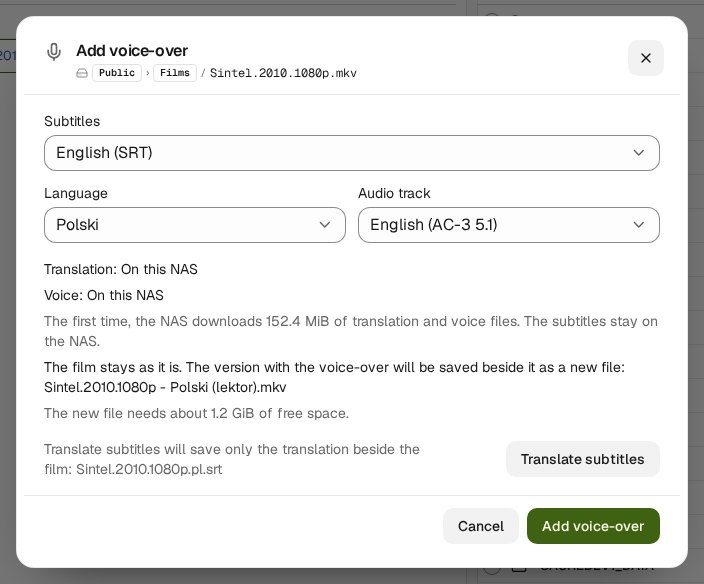
A voice-over in a few clicks, without any key. In Files, open a film's menu and choose Tools › Add voice-over…. The window has already picked the subtitles, the language and the sound track. Press Add voice-over and one job in the jobs list does the rest; you can stop it at any time. The NAS translates the subtitles, reads them aloud, mixes the voice into the centre channel (both sides in a stereo film) with the original about 5 dB quieter under it, and saves Film - Polski (lektor).mkv beside the film. The new file keeps every track of the film; the voice-over track comes right after the original sound and plays by default. The film itself is not changed, so a torrent that seeds it keeps its data.
Everything on the NAS. Without a key the subtitles never leave the NAS: Argos translates English into Polish, Bergamot (the engine behind Firefox's translations) every other pair, and a Piper voice reads (Polish, German, French, Italian, Dutch or Swedish). When the film already has subtitles in the language you pick, the window uses them and translates nothing. The first time, the NAS downloads the programs and models it needs from pub.qnaputilities.com (about 152 MiB for English into Polish) and shows each download in the job. On a test NAS (QTS, x86_64) a 15-minute film with 5.1 sound took about two and a half minutes and at most 264 MB of memory.
With your own OpenAI or ElevenLabs key, their models translate and their voices read. In Media library › AI translation and speech › Voice-over you can still keep the voice-over on the NAS (On this NAS, without a key).
Translate subtitles in the same window saves only the translation beside the film, as Film.pl.srt, which Plex, Jellyfin, Emby and Kodi read. It works for an MP4 too.
Minor
In the Media studio, a film's captions track has Add voice-over… in its menu and in Info.
Preview Read Aloud in the Media studio now lowers the original by 5 dB, gently, as the saved voice-over does (before: 12 dB, at once).
Media library › AI translation and speech. The OpenAI and ElevenLabs keys and the models that Translate Captions, Transcribe to Captions and Read Captions Aloud use now live in the Media library's settings, right after Subtitles. They are no longer under Settings › Files & storage. At first you see only the two key fields. Paste a key and press Save and check: the NAS asks the service which models this key can use, and only then do the choices appear. You pick models from a list instead of typing their names. Each model says in a few words what it is, and the line under the box says why you would choose it. Translation starts on gpt-6-luna and reading aloud on gpt-audio-1.5. If you kept the old reading settings (tts-1 with the voice alloy), Read Captions Aloud now uses gpt-audio-1.5 with the voice cedar; OpenAI retires tts-1 on 6 January 2027.
Voice samples. The play button beside Voice plays a sample: ElevenLabs' own sample of the voice, or for OpenAI a short sentence read once with your key and then kept on the NAS.
Clear key errors. A key that works but lacks a permission now says which one and what to allow. A restricted ElevenLabs key needs Voices (Read), Text to Speech and Speech to Text.
Minor
RSS › Log: a pass started with Run now or Check now could be missing from the Log for one refresh after it ended. The Log now shows it as soon as its job is gone.
CA certificates now keep themselves current. Each release ships the newest Mozilla list of trusted certificate authorities (in this one, the list of 2026-11-05), and once a day the NAS asks curl.se whether a newer list exists. A newer list replaces the old one only after its checksum matches and every certificate in it can be read. rtorrent, the panel and curl trust this list instead of the firmware's, and an upgrade no longer puts back the list of the first install.
Guides › Media studio: AI subtitle translation and an AI voice-over, step by step. A new section, in English and Polish, from the API keys to the saved MKV, with figures drawn from the studio's own windows.
Files › Subtitles: each service is a badge. The five subtitle services show as one row of badges with the state's colour, an icon and the number of subtitles found. Tap or hover a badge for the full sentence.